SS United States: Get Back to Work! Reuse of Parts Salvaged from the Big U
Updated: Aug 26
It is now public knowledge, that the current owners of the SS United States, (Okaloosa County) helped to secure access for roughly 40 people representing 10+ museum ships as well as the SS United States Conservancy for the purpose of removing artifacts and parts to be used in displays, and in some cases, to be put back to use after sitting idle for several decades. While many of these parts now sit in storerooms waiting for their calling in general purpose compartment upkeep/restoration, there were a number of “targeted” components which were researched and were subject to extensive effort to remove. Today, I’ll write about a group of electrical transformers which were removed from the forward emergency generator compartment, formerly located underneath the forward stack on the ship.

To start, I need to mention that when you visit a museum ship, there is a high chance it is using original electrical components. Distribution boards, breakers, transformers, you name it. The main issue is cost. It would cost too much to redo an entire ship's worth of electrical, and so maintaining a system as it was built is the default choice. There are modern replacement parts that can do what we need, but they are both expensive and would distract from the look of a space. Put briefly, a transformer aboard ship is used to convert some input voltage to another. For example, I may have a generator aboard ship outputting 480V electrical. A transformer can take that and “transform” it down to 110V for a lighting circuit. In the case of a museum or naval ship, we may have 480V from the lines coming aboard, but the lighting circuits are 110V. This is where transformers come in. Keeping systems properly configured keeps ground faults from the ship which lead to accelerated rusting via galvanic corrosion.
The recovery efforts involved much back and forth between museum ship crews, the conservancy, as well as the ship owners and the contractor doing the remediation to ensure safe circuits, and a plan to physically move these very heavy units. These specific transformers were in a row, bolted to the wall at deck level, with cables running between. The ship, having only been in service for 17 years makes these units about 50 years younger than anything aboard their destination vessel ex-USS Croaker operationally speaking. It’s about as “new old stock” as you’re going to get for your 80+ year old warship. Since our time was limited, the cables were cut, and they were unbolted from their mounts.

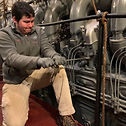
Next came the task of bringing these from the highest deck on the ship down to the shore, which made gratuitous use of chain falls and hand trucks. Needless to say, this was very hard work, being done by volunteers. The final removal from the ship was thanks to a telehandler with a bucket. Fast forward 1,100 miles, and 18 hours of driving. The transformers were cleaned up, tested, then installed aboard ex-USS Croaker, replacing non original workarounds and wiring. The result is a functional, contemporary solution for Croaker. These transformers are responsible for all the power aboard the submarine now. More lights can now be on, meaning visitors get a more authentic and enjoyable walk through when they visit.

With some luck, and good upkeep, these units will continue to function for the remaining lifespan of the vessel, and even beyond. Not bad for something that would have otherwise been in a scrap pile or at the bottom of the ocean. While SS United States will be sitting on the bottom later this year, at least some of her equipment will be topside. Whether that be a static museum display, transformers happily humming after being silent for decades, or an air compressor sprung to life again. SS United States lives on through her passengers, her crew, her artifacts in museums. Until next time.
Photos provided by Buffalo Naval Park


Comments